
Art Project: Pitaa Kani ∙ Who am I?
personal archive • multicultural • multiracial •identity
Asturias, Spain 2024Pitáa Kani, from Quechua (Runasimi: "language of the people"), meaning "Who am I?", is the titlel for this project. The piece consists of a portrait that alludes to the portraits made during the colonial era in what was the Viceroyalty of Peru, symbolizing the fusion of cultures within my mestizo identity. This piece visually and sculpturally combines elements that explore identity, heritage, and their hybridization. Integrating elements of indigenous Peruvian culture and European artistic influences, the work not only speaks of mestizaje but also embodies elements that, belonging to different cultures, are dissonant with each other.
One of the primary objectives for creating this piece was to find elements that represented me and that could fit within the limited space of the sphere, which has a diameter of 9 centimeters. On the other hand, the aim was to create a piece that engages in a dialogue with the complexity of mestizo identity through art, blending elements of my Quechua culture with my colonial history, and inviting the viewer to engage in their own mental work and draw their own conclusions and analyses from what they observe.
EXPLORATION OF IDENTITY
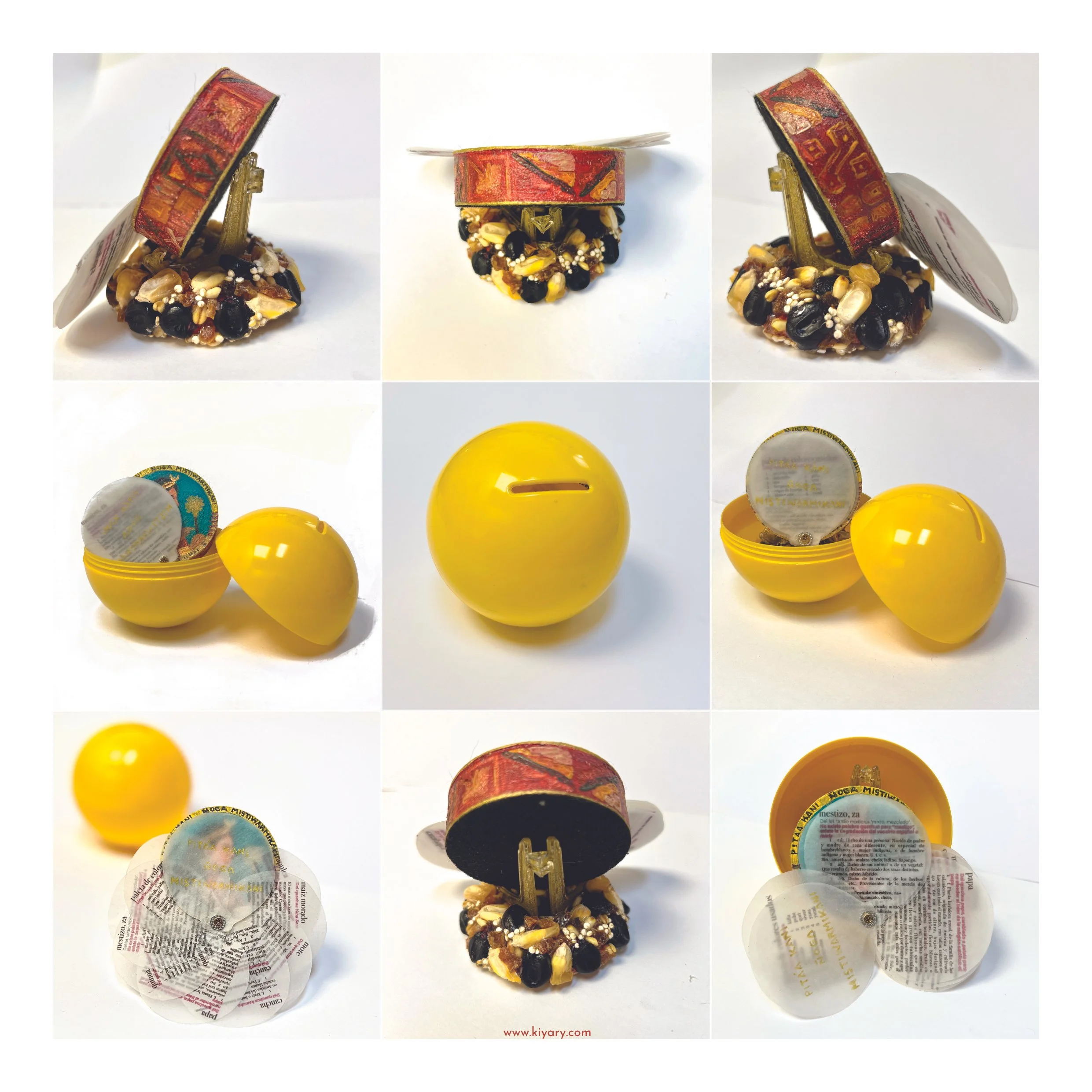
The portrait was created based on the design of colonial portraits, where the person's name was placed around the subject, with a gold border, to denote their level of nobility. However, in this case, instead of a name, we see a phrase in Quechua.
The use of the Quechua language (runasimi) has been fundamental in highlighting the origin of the metaphors of the indigenous culture of South America. Both the phrase surrounding the portrait, questioning Pitáa Kani (Who am I?) and the response Ñoga mistywarmikani (I am mestizo), contribute to questioning what we see.
The tension created by the definitions of various Quechua words, printed on tracing paper discs, draws a latent but almost transparent connection to the person; for example, the word mestizo, which has no direct Quechua translation because the concept of otherness comes from Western culture; or the word papa, which is the tuber known as potato in Spain, and which was changed to be translated into Spanish, and other words that fortunately have maintained their form and phonetics (as close as possible) upon being incorporated into the dictionary of the Spanish language. The colors used for the portrait have been carefully chosen for their composition and technical names: Indian red, Indian yellow, white, black, turquoise, and gold. These same colors have been used in Inca and pre-Columbian art in general, due to their natural origins. Likewise, these colors have also been listed and translated into Quechua on one of the paper discs placed above the portrait. The portrait's attire features designs inspired by Inca textiles, emphasizing this blend of cultures.
The circular shape of both the portrait and the discs with the definitions adds to the pre-Columbian symbolism where circular forms are associated with cycles and the great deities: sun and moon.
The portrait and the discs are placed on a kind of pedestal made from the seeds of the foods mentioned on the discs: cancha (toasted corn), purple corn, carapulcra (dried potatoes), quinoa, and mote (hominy). These are ingredients commonly found in any Peruvian kitchen, and used daily for various dishes, but they would be difficult to obtain and find in a Spanish kitchen, much less an English one, which are the other two origins of my racial/cultural mix.
Technical Details:
The piece measures 7.5 cm high by 7 cm wide. The wooden disc measures 6 cm in diameter by 2 cm high. The sphere containing the piece measures 9 cm in diameter.
• Wooden Disc
• Oil paints: Indian red, Indian yellow, zinc white, black, turquoise, and gold
• Seeds and grains of mote (hulled wheat), cancha (toasted corn kernels), purple corn, quinoa, and dried potatoes
• Tracing paper
• Gold-painted methacrylate stand
PROYECTO DE ARTE: Pitaa Kani ∙ ¿quién soy?
personal archive • multicultural • multiracial •identity
Asturias, España 2024Pitáa Kani, del quechua (Runasimi : lengua de la gente) Quién soy, es el título para este proyecto. La pieza se compone de un retrato que hace alegoría a los retratos realizados en la época colonial en lo que era el virreinato de Perú, simbolizando la fusión de culturas dentro de mi identidad mestiza. Esta pieza combina visualmente y de forma escultural elementos que exploran la identidad, la herencia y su hibridación. Integrando elementos de la cultura autóctona peruana y las influencias artísticas europeas; se presenta una obra que no sólo habla del mestizaje sino que encarna en sí elementos que al pertenecer a culturas distintas son disonantes entre sí.
Uno de los objetivos primordiales para la realización de esta pieza fue buscar elementos que me representaran y que pudieran entrar dentro del espacio limitado de la esfera, cuyo diámetro es de 9 centímetros. Por otro lado, realizar una pieza que cree un diálogo con la complejidad de la identidad mestiza a través del arte, y que mezcle elementos de mi cultura quechua con mi historia colonial, y que invite al espectador a realizar sus propia obra mental y saca sus propias conclusiones y análisis a partir de lo que observa.
EXPLORATION OF IDENTITY
El retrato ha sido realizado basándose en el diseño de los retratos coloniales, donde el nombre de la persona era colocado alrededor del retratado, con un ribete dorado para hacer notar el nivel de nobleza de la persona, pero en este caso en vez del nombre observamos una frase en Quechua.
El uso del idioma quechua (runasimi) ha sido fundamental para señalar el origen de las metáforas de la cultura autóctona de América del Sur. Tanto en la frase que rodea el retrato, cuestionando Pitáa Kani ( Quién soy?) y la respuesta Ñoga mistywarmikani (Yo soy mestiza) ayudan a crear el cuestionamiento de lo que vemos.
La tensión que se crea con las definiciones de varias palabras quechua, impresas en discos de papel de trazar, trazan una conección latente pero casi transparente sobre la persona; como por ejemplo mestizo que no tiene una traduccion al quechua, debido a que el concepto de otredad viene de la cultura occidental; o la palabra papa, que es el tuberculo que se conoce como patata en España, y que fue cambiado a ser traducido al castellano, y otras palabras que afortunadamente han mantenido su forma y fonética (lo más cercana posible) al ser incorporados al diccionario de la lengua española.
Los colores usados para el retrato han sido cuidadosamente elegidos por su composición y nombres técnicos: rojo indio, amarillo indio, blanco, negro, turqueza y dorado, estos mismos colores han sido usados en el arte incaico y precolombino en general, por sus orígenes naturales. Así mismo, estos colores han sido también listados y traducidos al Quechua en uno de los discos de papel que van sobre el retrato. El atuendo del retrato lleva el diseño de los textiles incas, para hacer hincapié en esa mezcla de cultura.
La forma circular tanto del retrato como de los discos con las definiciones se añade a la simbología precolombina donde las formas circulares se conectan con los ciclos, y los grandes dioses: sol y luna. El retrato y los discos van colocados sobre una especie de pedestal realizado con semillas de los alimentos mencionadas en los discos: cancha, maíz morado, carapulcra (papa seca), quinua, mote; estos son ingredientes que se encuentran comúnmente en cualquier cocina peruana, y que se utilizan en una basis diaria para distintos potajes, pero serían difíciles de conseguir y encontrar en una cocina Española y muchos menos Inglesa, que son los otros dos orígenes de mi mezcla racial/ cultural.
Technical Details:
La pieza mide 7.5 cm de alto por 7 cm de ancho total. El disco de madera mide 6cm de diámetro por 2 cm de alto.
La esfera que contiene la pieza mide 9 cm de diámetro.
• Disco de Madera
• Pintura al óleo: rojo indio, amarillo indio, blanco zinc, negro, turquesa y dorado
• Semillas y granos de mote (trigo pelado), cancha, maiz morado, quinoa, papa seca
• Papel para trazar
• Stand de metacrilato pintado con dorado